The Daily Walkaround Check: What Actually Counts as a Defect?
Written by FleetForge editorial team · Published 27 September 2026 · Reviewed for UK fleet compliance guidance · 8 min read

The Daily Walkaround Check: What Actually Counts as a Defect?
Ask ten different drivers what counts as a defect on a walkaround check and you'll probably get ten different answers. Some will tell you it's only worth flagging if the vehicle can't move. Others will say they report everything, even a scuff on the bumper. Most land somewhere in the middle, relying on gut feel built up over years behind the wheel.
The problem is that gut feeling isn't a defence you can use with the DVSA.
We built FleetForge because we kept seeing the same issue: operators running decent fleets, with drivers who genuinely cared, but with walkaround check processes that wouldn't hold up under scrutiny. Paper forms that went missing. Defects that got spotted but never formally recorded. Checks completed in the yard with a quick glance and a signature.
This post is our attempt to cut through the confusion. What actually counts as a defect? What are you legally required to record? And how do you make sure nothing slips through the cracks?
The short answer: a defect is any condition that affects the safe operation of the vehicle, or that means it doesn't meet legal roadworthiness standards. But the detail matters enormously.
Why the Walkaround Check Exists
The daily walkaround check isn't a box-ticking exercise invented by regulators to make drivers' mornings harder. It exists because roadworthiness deteriorates between scheduled maintenance, and the person best placed to spot that deterioration is the driver who uses the vehicle every day.
Under Section 96 of the Road Traffic Act 1988, operators have a legal duty to ensure their vehicles are not used in a dangerous condition. The walkaround check is the practical mechanism for meeting that duty. The DVSA's Guide to Maintaining Roadworthiness sets out clearly that operators must have a system for drivers to report defects, and that those defects must be acted upon before the vehicle goes back on the road.
That last part is worth sitting with. It's not enough to have a driver complete a check. You need a documented record of what was inspected, what was found, and what happened next.
This is where most operators run into trouble. The check happens. The defect gets spotted. But the paper form sits in a cab, gets rained on, or never makes it back to the office.
What Counts as a Defect?
This is the question we get asked most often, and it's a fair one. The DVSA doesn't publish a single definitive list, but the principle is consistent: a defect is anything that makes the vehicle unsafe, illegal, or unfit for the road.
In practice, defects fall into two broad categories.
Category 1: Safety-Critical Defects
These are defects that must ground the vehicle immediately. The vehicle does not go out until the issue is resolved.
-
Brakes: any reduction in braking performance, unusual noise, or warning light
-
Steering: excessive play, stiffness, or pulling to one side
-
Tyres: damage, bulges, cuts, or tread depth below the legal minimum (1.6mm for most vehicles)
-
Lights: any non-functioning headlight, brake light, indicator, or hazard light
-
Windscreen: cracks or damage in the driver's line of sight
-
Fluid leaks: oil, brake fluid, or coolant visibly leaking
-
Load security: anything that could move, fall, or affect vehicle stability
If a driver spots any of the above, the vehicle stays put. Full stop.
Category 2: Minor Defects
These are issues that don't immediately ground the vehicle but must still be formally recorded and scheduled for repair.
-
Bodywork damage that doesn't affect safety or visibility
-
Non-critical warning lights (e.g. a service reminder)
-
Worn wiper blades that still clear the screen adequately
-
Minor interior damage
-
Low washer fluid
The key point here is that minor doesn't mean ignorable. A minor defect left unaddressed can become a safety-critical one. And if it's not recorded, you have no evidence that it was spotted, monitored, or managed.
Common mistake: drivers skipping the minor defect column because they assume it's not worth reporting. If it's not recorded, it didn't happen, and that's a problem if the DVSA comes knocking.
What the Check Should Actually Cover
A thorough walkaround check isn't a quick lap of the vehicle. It follows a systematic route and covers specific areas. The DVSA expects drivers to check the following as a minimum:
| Area | What to Check |
|---|---|
| Cab | Mirrors, seat, seatbelt, horn, dashboard warning lights |
| Engine bay | Oil level, coolant level, brake fluid, battery |
| Tyres and wheels | Tread depth, pressure, condition, wheel nuts |
| Lights | All front and rear lights, indicators, hazards |
| Bodywork | Panels, doors, windows, load restraints |
| Underside | Visible leaks, exhaust condition |
| Fuel and AdBlue | Levels adequate for the planned journey |
This isn't an exhaustive list for every vehicle type. Buses, coaches, and HGVs each have additional requirements, and your inspection template should reflect the specific vehicle being checked.
The Importance of a Structured Template
One of the most common weaknesses we see in operator compliance records is an inconsistent check format. When every driver completes the check slightly differently, it's almost impossible to demonstrate a systematic process to a DVSA examiner.
A structured template solves this. It sets out exactly what needs to be checked, in what order, with no room for ambiguity. It also means a new or temporary driver can complete the check to the same standard as your most experienced member of staff.
How FleetForge Handles Walkaround Checks
This is where we'll be honest about why we built the walkaround check feature the way we did.
Paper-based checks have one fundamental flaw: they rely entirely on the paper making it from the driver's hand to the right person's desk. In a busy operation, that chain breaks constantly. Forms get left in vehicles. Defects get noted but never actioned. And when a DVSA examiner asks to see your inspection records, "we do check, we just don't always keep the forms" is not a conversation you want to be having.
In FleetForge, walkaround checks are completed digitally, on mobile, at the vehicle. The driver logs the inspection against a specific vehicle and template, records their odometer reading, captures their location, and works through a structured checklist. Photos can be attached directly to any item. The inspector signs off digitally.
Here's what that looks like in practice (this is the desktop view - drivers complete the same form on their phone via the FleetForge mobile app, with a layout optimised for smaller screens):
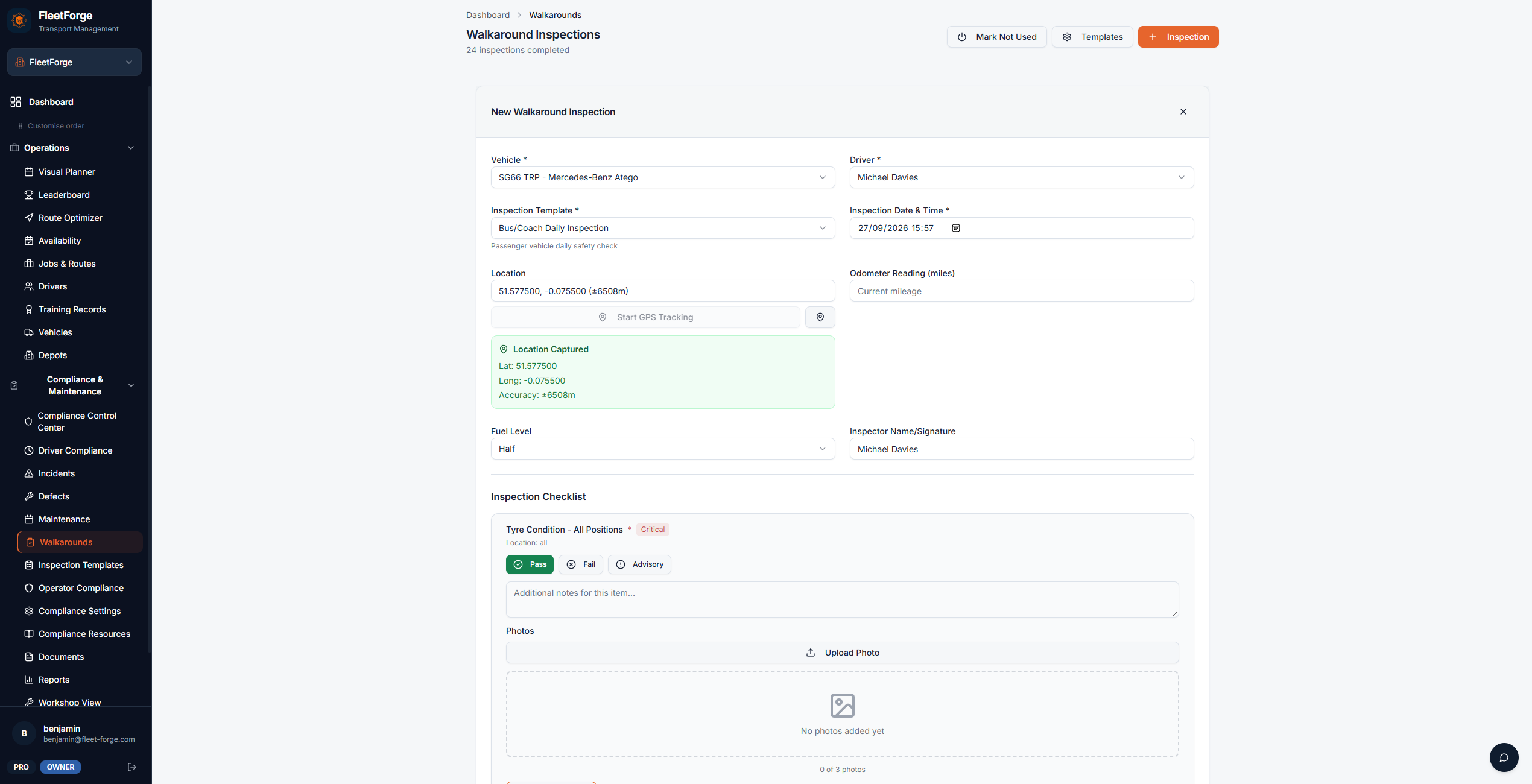
Whether a driver is completing the check on their phone in the yard or a manager is logging an inspection from the office, the same structured form, the same data capture, and the same audit trail. Every inspection is timestamped, linked to the vehicle record, and immediately visible to management. There's no delay between a driver completing a check and the operations team seeing the result.
What Happens When a Defect Is Flagged?
This is the part that matters most from a compliance standpoint. Spotting a defect is only half the job. The other half is making sure it's actioned, documented, and resolved before the vehicle goes back on the road.
When a defect is recorded in FleetForge, it flows directly into the defect management workflow. The relevant team member is notified, the defect is tracked through to resolution, and the full history sits on the vehicle record. If a DVSA examiner asks to see evidence that a defect was identified, reported, and resolved, you can pull that record in seconds.
That audit trail is what separates operators who pass DVSA assessments from those who don't. It's not about having a perfect fleet. It's about being able to demonstrate that you have a system, and that the system works.
The Mistakes We See Most Often
After working with operators across the UK, a few patterns come up repeatedly. These aren't failures of intent. They're failures of process, and they're entirely fixable.
1. Checks completed retrospectively The check is supposed to happen before the vehicle moves. Completing it after the journey, or at the end of a shift, defeats the purpose entirely. If a defect develops during a journey, it won't be caught. And if the timestamp on your records doesn't match the departure time, that's a red flag for any examiner.
2. No record of "nil defect" checks If a driver completes a check and finds nothing wrong, that still needs to be recorded. A nil defect report is evidence that the check happened. Without it, you have no proof the vehicle was inspected at all.
3. Defects recorded but not resolved The check is only the start of the process. We've seen operators with thorough inspection records that clearly show a defect was flagged, then flagged again the following week, then again the week after. That's not compliance. That's a paper trail of unresolved issues.
4. One driver, one check, one vehicle When a vehicle changes hands mid-shift or is used by multiple drivers in a day, each handover should be documented. A single morning check doesn't cover the full operational day if the vehicle is being used by different people.
5. Templates that don't match the vehicle A generic check template applied to a specialist vehicle will miss things. Your inspection templates should be tailored to the vehicle type, and reviewed periodically to make sure they still reflect the vehicle's actual condition and any changes to legal requirements.
Getting It Right
The daily walkaround check is one of the most straightforward compliance requirements in transport operations, and yet it's one of the most commonly done poorly. Not because operators don't care, but because the traditional paper-based process creates too many opportunities for things to go wrong.
Getting it right comes down to three things:
-
A structured template that covers your specific vehicle types and leaves no room for interpretation
-
A consistent process that happens before every journey, every time, with a timestamped record
-
A clear workflow for what happens when a defect is found, from notification through to resolution and sign-off
When those three things are in place, the walkaround check stops being a source of compliance anxiety and starts being exactly what it's supposed to be: evidence that your operation is well-run.
If you're still managing checks on paper, or relying on drivers to remember the process without a structured prompt, it might be worth taking a look at how FleetForge approaches it. We've built the walkaround check feature around the way operators actually work, not the way regulators imagine they work.
Tags: